
To generate high lift during takeoff and landing, airplanes use flaps — a hinged panel at the trailing edge of the wing that deflects downward. The flap rotation about the hinge is a sharp, discrete deflection. Now, what if instead of that sharp bend, the entire trailing portion of the wing curved smoothly, more like how a bird adjusts its wing? That is the idea behind smooth camber morphing.
There’s already good evidence — from both simulations and experiments — that smooth camber morphing reduces drag compared to a conventional hinged flap, at the wing level. But does this advantage carry over to airplane level, wherein there is also a tail to keep the airplane trimmed?
Ravi, a PhD student co-advised by Prof. Santanu Ghosh and me, looked at this as part of his thesis. The short answer: yes, smooth camber morphing does remain advantageous at the aircraft level — but mainly during takeoff, landing, and low-speed cruise.
The trim drag problem
Here is the complication that makes the aircraft-level question non-trivial. When you deflect a flap — whether hinged or morphed — you increase the lift. But because that extra lift is generated near the trailing edge, it also creates a nose-down pitching moment. For the airplane to fly steady, the tail has to produce a downward lift to counteract that moment. This additional lift from the tail, got by an incremental elevator deflection, will introduce its own drag, thus increasing the trim drag.
So the question is: does this extra trim drag cancel out the drag savings that smooth morphing gives you at the wing level? That is not obvious, and it has to be worked out for the wing-tail configuration.
An additional problem: flap-tip vortex
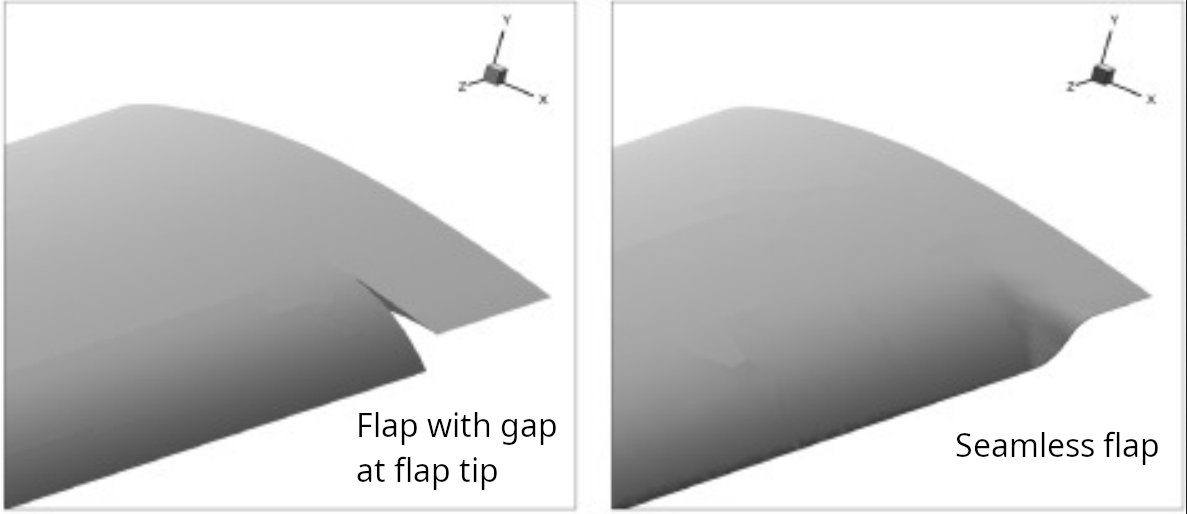
There is a second issue, which is separate from the trim drag question. Even if the flap itself morphs smoothly, if it is a separate piece from the wing — the way most real flaps are — there is a gap at the flap tip. Air leaks through that gap, and you get a small vortex forming there, similar to a wing-tip vortex. This creates extra drag.
Some studies have used spanwise-seamless camber-morphing flaps (S-SCMF) to mitigate this problem. So another objective of Ravi’s thesis was to study how effective those flags are. A comparative study of the effectiveness of S-SCMF and regular smooth camber-morphed flaps (SCMF) conducted at the wing level is reported in another paper published by us.
The study
In this study, Ravi compared two different flap configurations. A flap is fundamentally a camber-morphing device — it changes the shape of the wing’s cross-section (the camber) to generate more lift. The difference is just in how that morphing happens. The two configurations compared in the study are: Hinged Flap, where the deflection of flap (morphing) is a rigid rotation about a hinge, and Smooth Camber-Morphed, where the flap deflection causes a smooth bend.
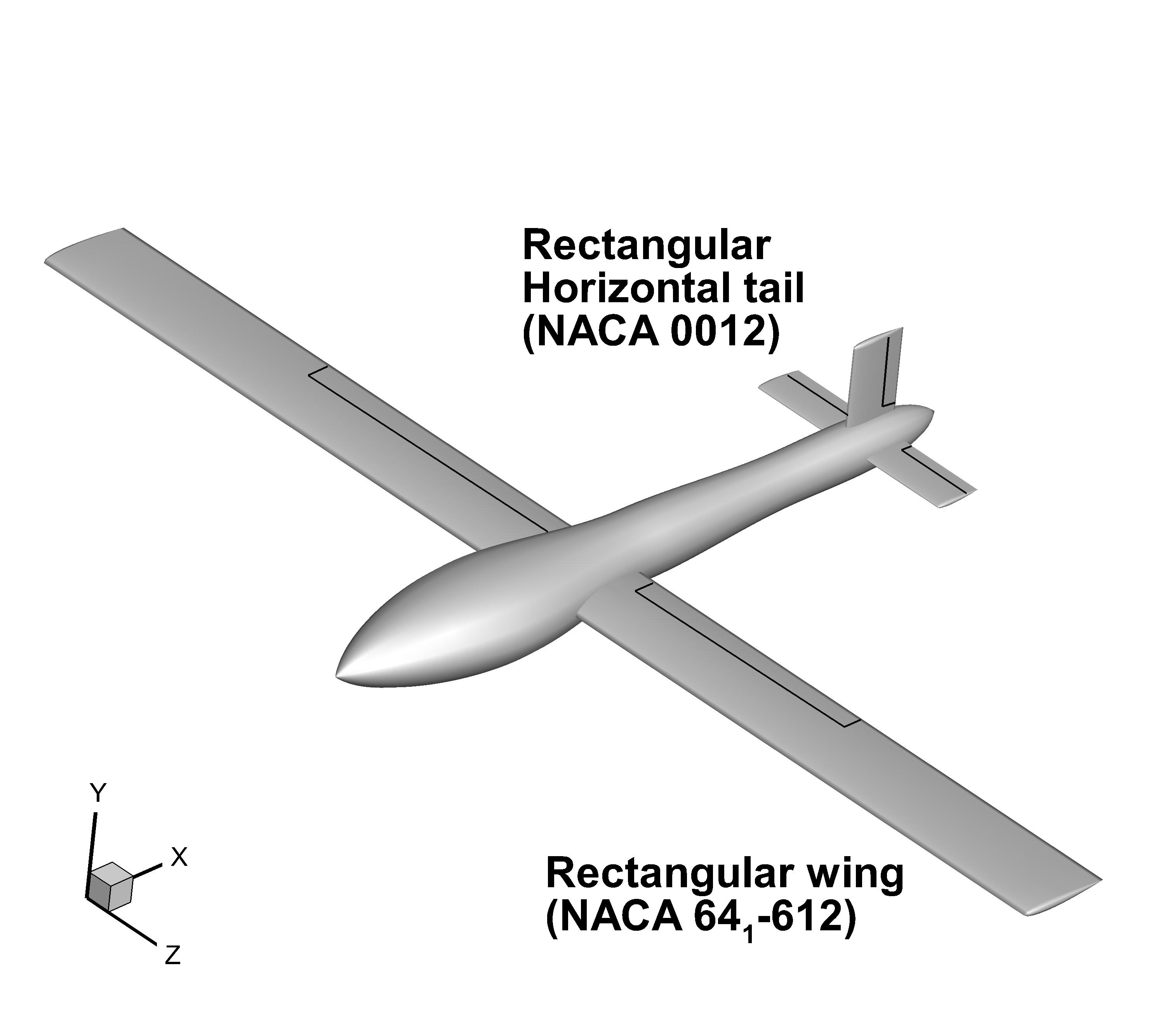
The study is conducted at the aircraft level – it’s not only the wing, but the tail with an elevator is also added into the picture. For the smooth camber-morphed system, not only the flaps, but the elevator too deflect via smooth camber-morphing. The simulation setup The study used computational fluid dynamics (CFD) — basically, solving the fluid flow equations numerically on a computer. The solver was ANSYS Fluent, using the RANS (Reynolds-Averaged Navier-Stokes) equations. A turbulence model coupled with a transition model (details in the paper) was used to capture the laminar-turbulent transition effects. This matters because the wing uses a low-drag airfoil (NACA 64₁-612) that is specifically designed to keep the boundary layer laminar over a good portion of the chord. If you don’t model where that laminar-to-turbulent transition happens, you will get the drag wrong. For the tail, a symmetric NACA 0012 airfoil was used. Simulations were run at two Reynolds numbers: 1×10⁶ for takeoff and landing, and 1.216×10⁶ for cruise.
What the results show
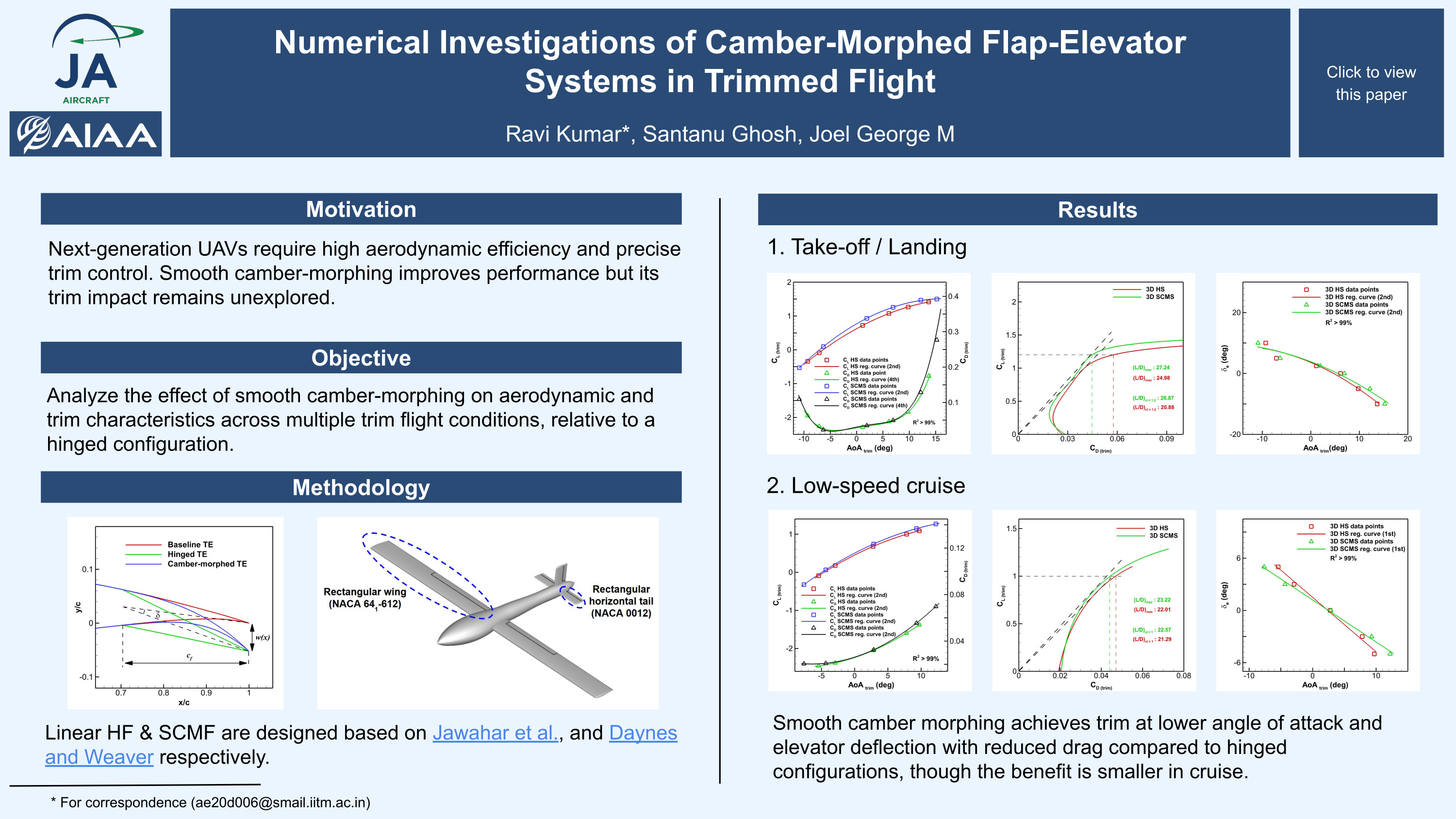
At the aircraft or system level, Ravi studied a smooth camber-morphed system (SCMS) where both the flap and the elevator deform continuously, compared against a conventional hinged system (HS) where both are hinged.
At takeoff and landing conditions — where the flap is deployed and high lift is required — the smooth camber-morphed configuration (SCMS) gives lower drag for the same lift coefficient, even after accounting for trim. The morphed elevator is more efficient at generating the lift required to trim, so the trim drag is lower too. The net result is that the advantage seen at the wing level does carry over to the full aircraft.
During low-speed cruise, the advantage persists. But during normal cruise flight — where neither configuration has the flap deployed — both behave almost identically. With no flap deflection, there is no differential benefit from morphing, and the elevator deflections needed for trim are small enough that the differences don’t really show up.
Why this matters more than it might seem
It is tempting to think: if the benefit is only during takeoff and landing, how important is it really? Takeoff and landing are the phases that decide how big your engines need to be. During cruise, a typical aircraft needs thrust equal to only about 1/15th of its weight — because the lift-to-drag ratio is around 15. But the engine has to be sized for takeoff and initial climb, where a thrust-to-weight ratio of around 0.3 is typical. So the engines are doing their hardest work right when the flaps are deployed.
If morphed flaps reduce the drag during that phase, you can achieve the same takeoff performance with a smaller thrust requirement, which means smaller and lighter engines, which results in a lighter aircraft overall. It is one of those design-spiral benefits that looks modest, but compounds through the whole system into a considerable advantage!
Here is a graphical abstract of our work:
Related publication
- Ravi Kumar, Santanu Ghosh, & Joel George Manathara,
Numerical investigations of camber-morphed flap-elevator systems in trimmed flight,
Journal of Aircraft, 2026. doi:10.2514/1.C038739