PhD - Initial vs Later Days

created using Gemini

created using Gemini
Novice researchers often make the mistake of using the Future Work
section of their papers to list their own upcoming plans. However, individuals and personal research agendas are secondary. The enduring value of your research contribution lies in the fresh horizon of ignorance you have mapped for the entire community. Crafting a meaningful future work section requires recognizing the difference between narrating your to-do list and describing an ‘updated map’.

To generate high lift during takeoff and landing, airplanes use flaps — a hinged panel at the trailing edge of the wing that deflects downward. The flap rotation about the hinge is a sharp, discrete deflection. Now, what if instead of that sharp bend, the entire trailing portion of the wing curved smoothly, more like how a bird adjusts its wing? That is the idea behind smooth camber morphing.
There’s already good evidence — from both simulations and experiments — that smooth camber morphing reduces drag compared to a conventional hinged flap, at the wing level. But does this advantage carry over to airplane level, wherein there is also a tail to keep the airplane trimmed?
Ravi, a PhD student co-advised by Prof. Santanu Ghosh and me, looked at this as part of his thesis. The short answer: yes, smooth camber morphing does remain advantageous at the aircraft level — but mainly during takeoff, landing, and low-speed cruise.
PhD is commonly considered as the pinnacle of education — the highest degree and the final destination. Most people picture it as the grand finale — the end of all of that studying! But that is the wrong way to think about PhD for anyone considering this path. Think of a PhD less as graduation and more as admission — specifically, admission into the very beginning of an academic career. Think of it as the kindergarten of that world.

The traditional education system — with its syllabuses, timetables, and standardised exams — ends with your master’s degree. What comes next is a completely different game.
Whether it’s military reconnaissance or wedding photography, using quadrotors (also known as multirotors) has become the standard. However, one of the primary limitations of today’s electric motor multirotors is their limited endurance, which is primarily due to battery capacity.
Using internal combustion (IC) engines would be much more efficient. While gasoline offers more than 25 times the energy density of lithium-polymer batteries, IC engines respond sluggishly compared to electric motors. Anyone who has driven a car with an IC engine knows the lag between pressing the accelerator and feeling the engine respond—a delay that would be catastrophic for a quadrotor trying to maintain stable flight.
Quadrotors are inherently unstable flying machines. They stay airborne and level only because their electric motors can change speed in milliseconds, constantly adjusting thrust to maintain balance. Owing to delays in carburetors, fuel-air mixing, and combustion cycles, an IC engine seems fundamentally incompatible with the rapid response required to stabilize an IC engine-powered quadrotor.
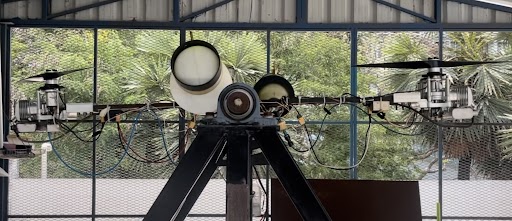 IC engine-based bi-rotor on a test stand
Equipping IC engines for quadrotor control is akin to transforming a marathon runner into a 100-meter sprint champion. That’s the engineering challenge Ajith, a PhD student whom I am co-guiding with Prof. Ramakrishna, tackled in his research, the results of which are published in an article titled “Throttle-controlled internal combustion engines as propulsion and control units for high endurance quadrotors: a feasibility study,” recently published in Aerospace Science and Technology.