Propeller selection is a crucial stage in airplane design. A poor selection can result in an inefficient design.
Designers of small UAVs are often faced with a hurdle in the propeller selection stage in preliminary design due to the lack of simple yet accurate models to estimate small propellers’ performance (thrust coefficient, power coefficient, and efficiency at various combinations of forward speeds and propeller RPMs). It might even seem impossible to have accurate propeller performance models as the performance depends on the propeller geometry (airfoil characteristics, chord length, radius, and linear pitch). And small propellers have complex geometries, the details of which are proprietary and not publically available.
Nonetheless, we could still have accurate yet simple propeller models. That is what Siddhardha and I showed in our work published recently in Aerospace Systems.
Unmanned Aerial Vehicles (UAVs) have moved from the phase of ‘on paper’ applications to real-world applications.
In the early days of computers, people bought computers to use specific programs that came installed with the computer. Such software were called killer apps. Computers got sold for want of the killer apps.
UAVs are currently in that phase. UAV companies are selling their vehicles by advertising the specific application that their UAV is best at performing: for DJI, the killer app is drone photography; for Skydio, it is inspection, mapping, and survey; for Yamaha, it is precision agriculture; for many other companies, it is package delivery.
One of the recent applications of UAVs is in weather monitoring. In a previous post, I mentioned that one of the thrust areas of the Geophysical Flows Lab is using UAVs for field measurements. UAVs can acquire data with temporal and spatial resolutions that are missing in the data obtained using the current measurement systems.
If there is a fire breakout in the International Space Station (ISS), will the fire propagate as if on Earth?
There are these fantastic experiments done onboard ISS that reveal how physical phenomena behave differently under microgravity conditions.
To study how physical and biological processes behave in microgravity conditions, we need to create microgravity. ISS naturally has microgravity, but access to ISS as an experimental platform is limited and expensive. A facility that allows us to simulate microgravity on Earth is a drop-tower — a tall tower from which the experimental set-up can be ‘dropped’ and the set-up experiences microgravity during the resultant free-fall. Building these tall drop-towers takes time and is costly.
Siddhardha, as part of his PhD thesis, proposed that multirotors can be turned into microgravity platforms. Thus, now we have a portable, cheap, and versatile microgravity platform.
Siddhardha’s work was featured as a news article in various newspapers.
Geophysical flows refer to the motion and behavior of fluids, such as air and water, in the Earth’s atmosphere and oceans. These flows are influenced by gravity, Earth’s rotation, temperature differences, and pressure gradients, and they exhibit a wide range of complex and nonlinear behavior. Geophysical flows can occur over a wide range of scales, from microscopic to planetary, and can have important implications for the Earth’s climate and weather patterns.
Examples of geophysical flows include ocean currents and atmospheric circulation. Understanding these flows is essential for predicting and mitigating natural hazards such as hurricanes, as well as for understanding the long-term dynamics of the Earth's climate and environment.
Petrola & Woods (2018)
The study of geophysical flows involves the application of (i) mathematical models, (ii) observational data, and (iii) laboratory experiments to understand better the underlying physical processes that govern the behavior of fluids in the Earth system.
Geophysical Flows Lab, a Centre of Excellence at IIT Madras, is set up to make advances in the above three aspects with the vision of unlocking the mystery of Earth's cimalte mechanism.


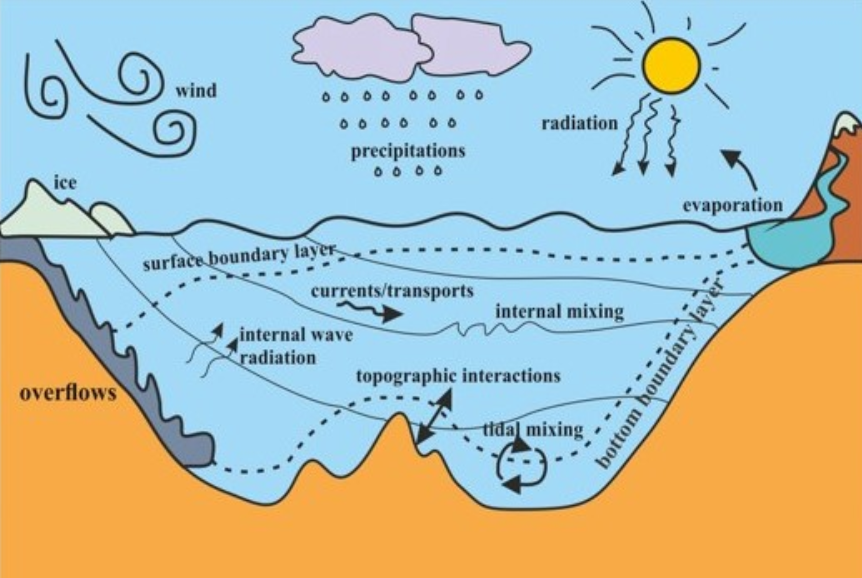 Petrola & Woods (2018)